← All projects

A paper-and-ink typing tutor with browser profiles, optional cloud saves, and teacher-managed classrooms. Designed for a physical keyboard and a browser window of at least 1200 × 640; smaller screens show a device guide.

Role
Game design, front-end engineering, and classroom backend
Delivery
Self-hosted VPS + Docker
Availability
Public product
Rule
Wrong keys never advance

How it works

IN THE BROWSERKeyboardevery key checkedInk the Linesmudge · flowLocal saveper browserClass serveraggregates onlyTeacherroster · reportsFix-It drillsTXTRA / KEYSTROKE TO CLASSROOM

Swipe to see the whole system

  1. Accuracy is the only way forward

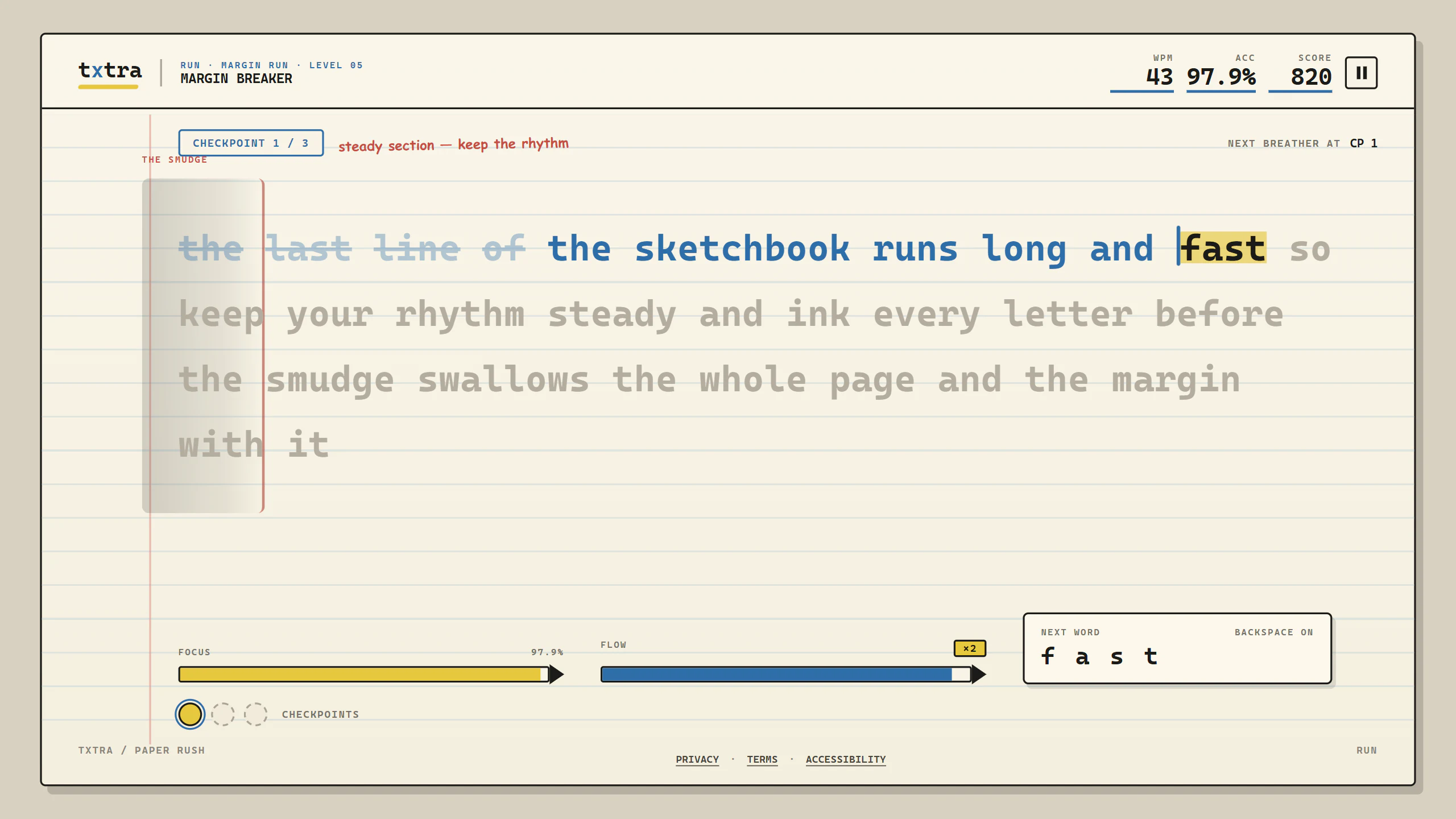
    A wrong key does not advance, so speed comes from a steady rhythm rather than bursts and corrections.

  2. Practice that answers your mistakes

    Every key's hits and misses are recorded locally, and the keys you miss most become short drills with no smudge and no score.

  3. Classrooms without accounts

    Students join with a code and a display name. Class boards rank improvement over each student's own baseline and only show students who opt in.

The problem

Typing tutors for children tend to be either drill software or games that reward raw speed, and the classroom versions usually want student email accounts and keep every keystroke on a vendor's servers. Neither teaches the habit that matters most: accuracy first, speed after.

My approach

txtra turns practice into a run across a paper sketchbook. Wrong keys never move the line forward, a smudge chases the pencil from behind, and clean letters build a flow multiplier. Progress is saved in the browser, with optional accounts for cloud saves. Teachers create a class and get a code, students join by typing it with only a display name, and the server keeps aggregate results rather than keystrokes.

Engineering scope

  1. Dependency-free JavaScript modules on a fixed 1600 × 900 stage, with a hash router, an offline service worker, and a strict same-origin Content Security Policy
  2. One Node.js process for the game and classroom API, with class-scoped HttpOnly cookies, rate limits, atomic JSON writes, daily snapshots, and retention limits
  3. Optional cloud saves in PostgreSQL with scrypt password hashes, recovery codes, and validated save payloads